A Johnson scallop screen, typically constructed from wedge wire (V-wire) or perforated plate, functions as an outer screen component that lines the inner wall of a radial flow reactor vessel. Its characteristic fan-shaped or scallop geometry helps support and retain the catalyst bed, while also facilitating even flow distribution.
Core Benefits & Operational Advantages for Johnson Scallops
• Mechanical Strength & Durability
Welded intersections of V-wire and support rods make Johnson scallop screens exceptionally robust, resistant to bending, collapsing, and thermal stress, ensuring consistent performance under cyclic temperature and pressure extremes.
• High Open Area & Low Pressure Drop
Despite fine slot openings (as small as 0.010 in, 0.25 mm), the design ensures a high percentage of open area, reducing pressure drop and enhancing flow efficiency.
• Reduced Catalyst Damage
Vertical slot orientation allows catalyst particles to slide smoothly without abrasion, minimising fines generation and protecting catalyst integrity.
• Ease of Installation & Maintenance
Modular design, individual scallop segments, enables simple installation and convenient replacement or repair during turnarounds, outperforming bulky outer basket systems.
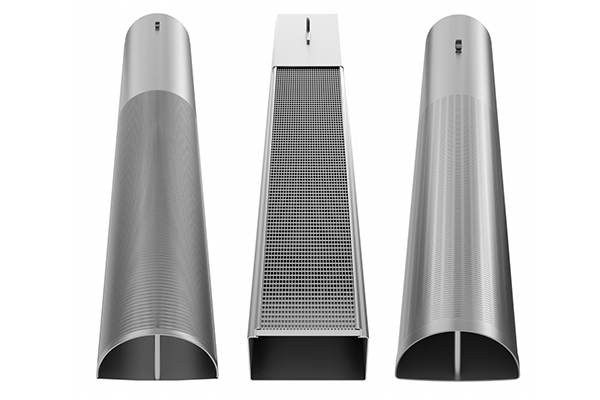
Scallop Types: Choosing the Right Solution
These robust wire-based designs are ideal for tall radial flow reactors. They offer mechanical strength, high open area, and reduced catalyst damage from fewer expander rings.
• OptiMiser Scallops
A hybrid that merges outer basket efficiency with scallop simplicity. OptiMiser scallops ensure a uniform catalyst bed, eliminate the need for expander rings, reduce coke formation, and offer tailored slot sizing.
• Perforated Plate Scallops
An economical choice: lighter, easier to install, and designed to deform under extreme loads, thereby acting as a safety valve that protects delicate inner components like centerpipes.
Where It Fits: Reactor Internals Overview
A radial flow reactor’s internals typically include:
Scallops (outer screen)
Centerpipes or inner screen
Outer baskets
Coverplates, support grids, lateral systems, and optional distributor trays.
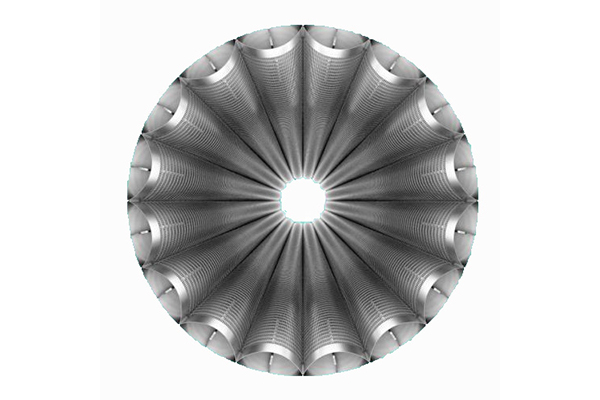
The scallop screen wraps the vessel’s interior, creating an annular catalyst bed that allows gases or liquids to flow radially inward or outward with even distribution and minimal channeling.
Industry Applications
Johnson scallop screens find applications across key refining and petrochemical processes:
✔ Catalytic reforming
✔ Hydrocracking and hydrotreating reactors
✔ Ammonia synthesis and conversion
✔ Styrene production
✔ FCC units, hydrogenation, dehydrogenation, gas treatment.
They are widely adopted in both new installations and revamp projects, favoured for their strength, flow control, and reliability.
Why Engineers Choose Johnson Scallop Screens
• Structural Integrity: V-wire designs withstand high loads and thermal cycling.
• Operational Efficiency: Excellent open area and vertical slots promote smooth flow and low pressure drop.
• Low Maintenance: Modular design and abrasion-resistant surfaces extend time between repairs.
• Customisable: Available in materials like SS304, SS316L, Inconel, Hastelloy, with slot sizes and geometries tailored to process demands.
• Safety: Perforated scallops deform under excessive load, protecting centerpipes and catalyst beds.
Johnson scallop screens for radial flow reactors are engineered for reliability, efficiency, and ease of operation, combining superior materials, precise manufacturing, and modular design to meet the most demanding refinery and petrochemical applications.
Choosing from Vee-Wire, OptiMiser, or perforated plate options enables tailored performance that enhances catalyst life, flow uniformity, and turnaround efficiency.